

TRANSFORMING BUILDING INFORMATION MODELS (BIM) INTO DIGITAL TWINS
FROM ARCHITECTURAL DESIGN TO CONSTRUCTION AND MAINTENANCE
Digital Twin at the University of Florida
In the College of Design, Construction, and Planning at the University of Florida, our research includes building information modeling (BIM), bi-directional data flow coordination, and machine learning (ML) prediction and simulation for built environment applications. This Digital Twin project combines these efforts by collaborating with Unreal, Autodesk, Siemens, and NVIDIA to enhance data visualization, IoT technologies, and ML applications in an applied research initiative. The primary goal is to test the transition from BIM LOD 400 to Digital Twin (DT). The project will involve working with three buildings: the DCP Collaboratory and Disability Resource Center (DRC), two new constructions, and remodeling the existing Student Infirmary. Heavener Hall, an existing building, is also being used as a preliminary DT proof of concept deployment. The insights gained from developing the DT for Heavener Hall will be crucial for the other three buildings. The ultimate Digital Twin will incorporate real-time information through automated processes, facilitating decision-making in building design, construction, and maintenance. The protocol developed through this project aims to be transferable and scalable, with the potential to be applied to other buildings within the University of Florida.
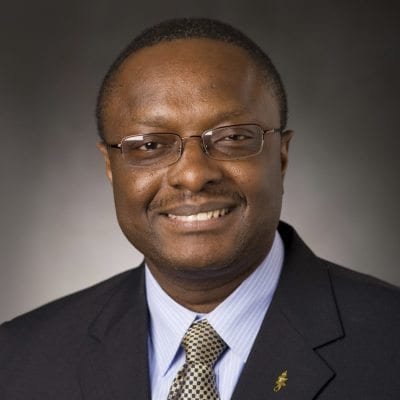
Dr. Chimay Anumba
Dean and Professor
College of Design, Construction and Planning


Dr. Ravi Srinivasan
Director of Graduate Programs and Research
M.E. Rinker, Sr. School of Construction Management
Dr. R. Raymond Issa
Distinguished Professor
M.E. Rinker, Sr. School of Construction Management

Dr. Karla Saldaña Ochoa
Assistant Professor
Director SHARE Lab
School of Architecture

Renn Handel
Research Software Engineer at UFIT Research Computing
Dr. David P. Norton
Vice President
UF Research

Elias G. Eldayrie
Vice President and Chief Information Officer UF


MEET THE TEAM
Deepak Balakrishnan
Ph.D. Student
M.E. Rinker, Sr. School of Construction Management

IMERZA
Yasin Delavar
Ph.D. Student
School of Architecture
Chady H. Elias
Ph.D. Student
M.E. Rinker, Sr. School of Construction Management
Principal Investigators:
Sponsors:
Students and Researchers:
NVIDIA


SIEMENS
Partnerships:

Erik Deumens
Director
HPC

Ying Zhang
HPC
Technical Support:

Zoe Ryan
Solutions Architect at NVIDIA

FACILITIES UF

PDC UF
What is Digital Twin?
Digital Twins (DT) are visual representations of physical objects or systems that have the potential to revolutionize the construction industry by facilitating more efficient, cost-effective, and sustainable building design, construction, and maintenance.
Depending on the level of detail and development the DT is classified into 5 categories.

Where we are standing now?
Building upon prior research conducted at the University of Florida, we have effectively transitioned from Existence Twin to BIM Status Twin. This advanced model predominantly incorporates static parametric data. In simpler terms, our digital twin for building now encompasses 3D models enriched with approximate geographical, physical, and key environmental data.

Where we are going?
Our trajectory leads us to the successive milestones of Operational, Simulation, and ultimately Cognitive Twins. In this progression, artificial intelligence plays a pivotal role, enabling comprehensive control over the digital twin. Advancing from BIM 200 to BIM 500, we will integrate and analyze real-time sensor-driven data, historical event predictions, and previously acquired details within the digital twin framework.
WHY DIGITAL TWINS?
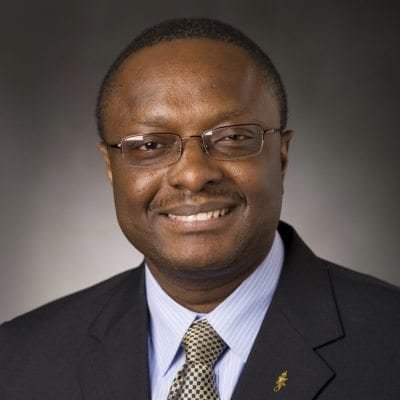
Dr. Chimay Anumba
“Despite proven efficacy in reducing injuries, improving safety management, and enhancing monitoring and control, their adoption in construction remains in its infancy. We illuminate opportunities in other sectors and advocate for increased deployment in construction. The integration of emerging technologies with physical construction is portrayed as the next-gen digital twin and cyber-physical systems, presenting potential scenarios for improving workforce productivity, health, safety, lifecycle management, and competency.”

Dr. Ravi Srinivasan
“Physics-based building energy modeling and machine learning techniques can provide faster and higher accuracy estimates, given buildings' historical energy consumption data. Looking beyond individual building levels, forecasting buildings’ energy performance helps city and community managers have a better understanding of their future energy needs, and plan for satisfying them more efficiently.”


Dr. R. Raymond Issa
“The financial digital twin (FinDT) framework integrates fund allocation and accounting with project acquisition in real-time and enables the owner to automate funding allocation tasks and to synchronize change management while ensuring compliance with funding restrictions. The goal of this framework is to leverage rule-based knowledge management to consolidate and continually optimize the efficient use of accurate financial information at all stages of the capital asset lifecycle. This is accomplished through automation and digital twin (DT) integration.”

Dr. Karla Saldaña Ochoa
“ We aim to develop a Digital Twin platform to enhance the decision-making abilities of Architecture, Engineering, and Construction (AEC) professionals. This platform will facilitate the testing of various scenarios, providing a virtual environment that is scalable and interoperable. The Digital Twin in this project comprises a network of real-time rendered 3D virtual worlds, allowing seamless collaboration across different scales while responding to human needs and inputs. By designing a Digital Twin with optimal information intensity, immersion, and interactivity, AEC practitioners can adopt a fresh perspective on their projects, engaging in a multi-sensorial experience.”

OUR OBJECTIVE
-

I. To conduct case studies on DT platforms from the AECO industry.
-
II. To characterize critical building design, construction and operational data requirements for UF campus
-

III. To create data management plan and data architecture
-

IV. To develop and demonstrate DTs to evaluate functionality and usability related to O&M and energy
-

V. To create and publish DT guidelines for UF campus
PILOT STUDIES WORKING TOWARD DIGITAL TWIN
UF CAMPUS TWIN
NVIDIA GTC 2025
Yasin Delavar, Dr. Karla Saldana Ochoa,
Dr. Chimey Anumba, Zoe Ryan
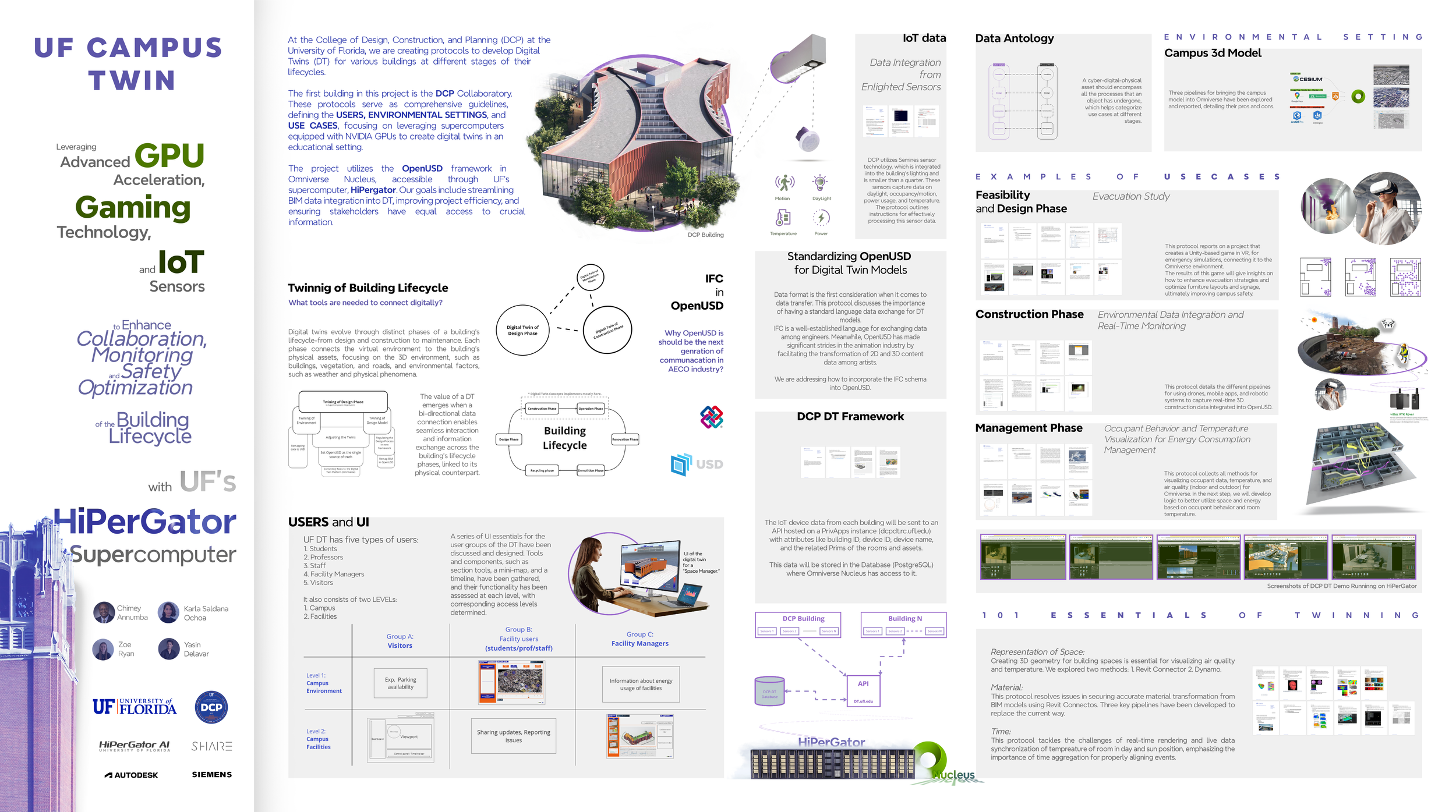
This poster outlines The UF DT project framework, goals, and novelty areas that will be exhibited at the GTC NVIDIA 2025 conference.
Handbook of Smart Built Environment
Edited By Professor Wilson Lu, Professor Chimay Anumba
This chapter outlines a theoretical framework for applying Digital Twins (DTs) throughout the building lifecycle, including design, construction, operation, and maintenance. It explores the role of building information modeling (BIM) in architecture, emphasizing the integration of data from physical buildings via the Internet of Things (IoT). The chapter highlights how BIM models, incorporating both 3D data and asset specifications, contribute to creating DTs with real-time IoT data. It also includes a comparative analysis of platforms for developing DTs, evaluating visualization, user interface, and sensor connectivity. The chapter examines user groups—developers, facility managers, and researchers—based on their roles in the lifecycle. Additionally, it discusses the future of DTs, particularly the integration of AI algorithms, and provides insights into their application at each lifecycle stage.


STATUS TWIN – ASSET MANAGEMENT
Dr. Chimay Anumba ,Dr. R. Raymond Issa, Dr. Kofi Asabere Bediako Asare
Internet of Things (IoT) platforms provide connectivity between physical and virtual environments. However, many IoT platforms lack the functionality of semantic and geometric representation of physical objects in digital formats. By combining the visualization capabilities of Unreal Engine and the IoT infrastructure provided by Microsoft Azure, this project created and tested a DT platform for real-time condition monitoring of constructed and managed assets.

SENSING AND SIMULATING – ML AGENT
Dr. Karla Saldana Ochoa, Wei-Chun Cheng
Using intelligent ML-agents as digital twins to replicate social dynamics within public spaces. These agents mimic human behavior and provide immediate responses to design interventions. Leveraging intelligent ML agents to facilitate the creation of a duplicated reality for predicting and evaluating design performance from a human perspective.
DIGITAL TWIN: SENSORS DATAFLOW: (Heavener Hall)
Dr. Ravi Srinivasan, Deepak Balakrishnan
Identification and Evaluation of DT platforms for Integration of Sensors:
Different commercially available Digital Twin platforms (Autodesk Tandem, Unreal Engine, Nvidia Omniverse, etc.) for buildings, were analyzed based on support for bidirectional flow of data between Digital Twin platforms (i.e. digital twin can receive data from the sensors to update its state and behavior, and also send data to the sensors to control the physical system) and sensors (Temperature, Humidity, etc.).
Based on Azure Digital Twin Workflow: GitHub - Azure-Samples/azure-digital-twins-unreal-integration: Sample project demonstrating the Unreal Engine plug-in for Azure Digital Twins

BIM TO TANDEM CONVERSION
Dr. R. Raymond Issa, Dr. Kofi Asabere Bediako Asare, Chady Elias
This study explores the transition from Building Information Modeling (BIM) to Digital Twin using Autodesk Tandem. A bi-directional flow of data requires essential modifications and additions to the as-built BIM model to render it compatible with facility management operations. The objective is to establish a scalable facility template for Digital Twin implementation at the University of Florida campus. This is achieved by employing a standardized asset classification system and aligning BIM asset information with the data structure requirements of the facility management system.

BUILDINGS INCLUDED ON THE PROJECT
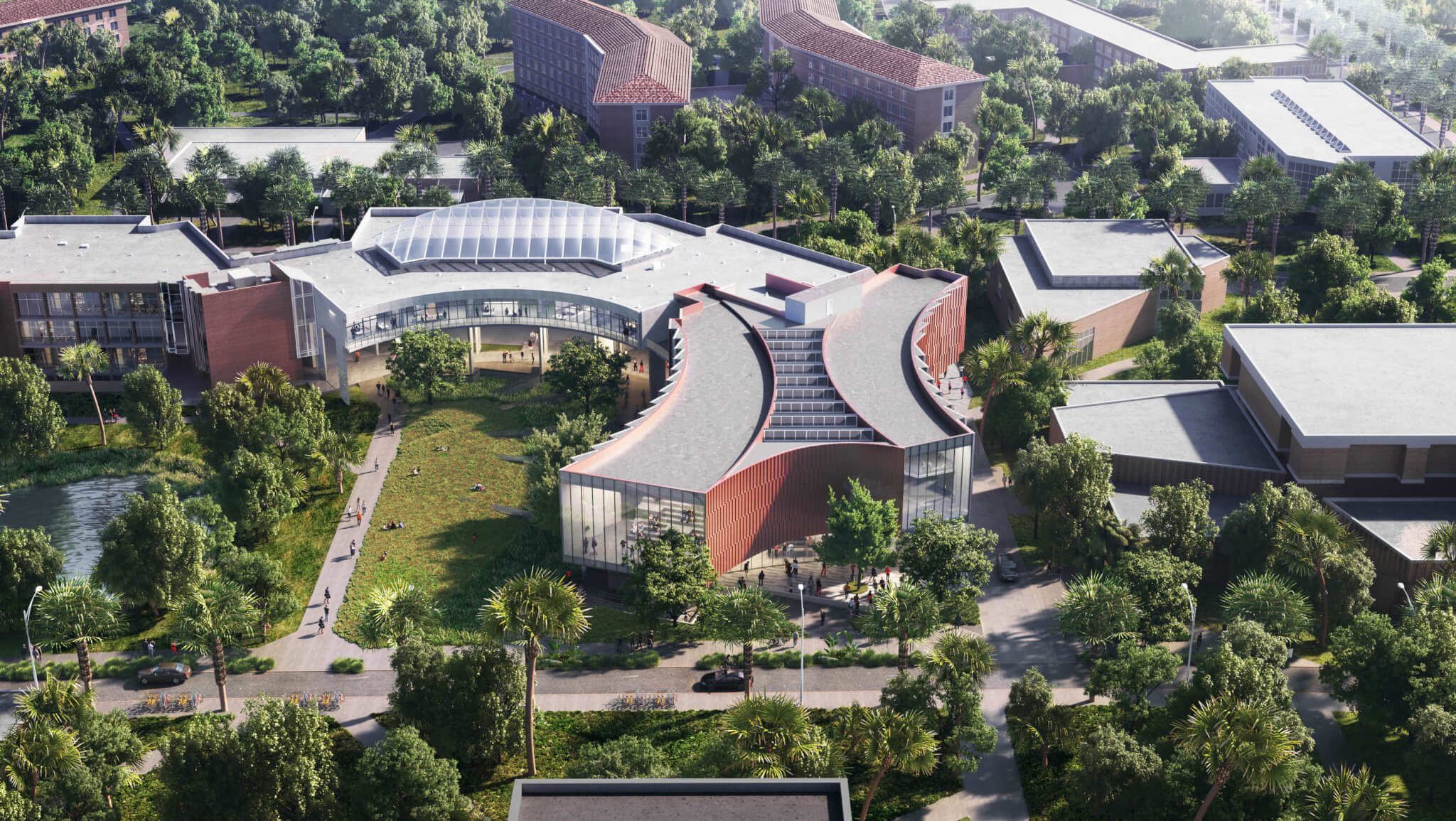
DCP Collaboratory
NEW CONSTRUCTED BUILDINGS
REMODELING AND REPURPOSING

Disability Resource Center
NEW TO-BE-CONSTRUCTED BUILDINGS

Student Infirmary

Heavener Hall
PRELIMINARY DT PROOF OF CONCEPT